How Many Calories Equal a Pound? The Complete Guide
Wondering how many calories equal a pound? Learn the science behind the 3,500-calorie rule and how to convert calories to lbs for weight loss.
How Many Calories Equal a Pound? The Complete Guide
When embarking on a fitness or weight loss journey, one of the first questions people ask is: how many calories to lbs? Understanding the relationship between energy intake and body weight is fundamental to achieving your goals. In this comprehensive guide, we will break down the science of how calories convert to pounds, explore the origins of the famous “3,500-calorie rule,” and show you how to apply this knowledge to your daily routine.
The Core Rule: How Many Calories to a Pound?
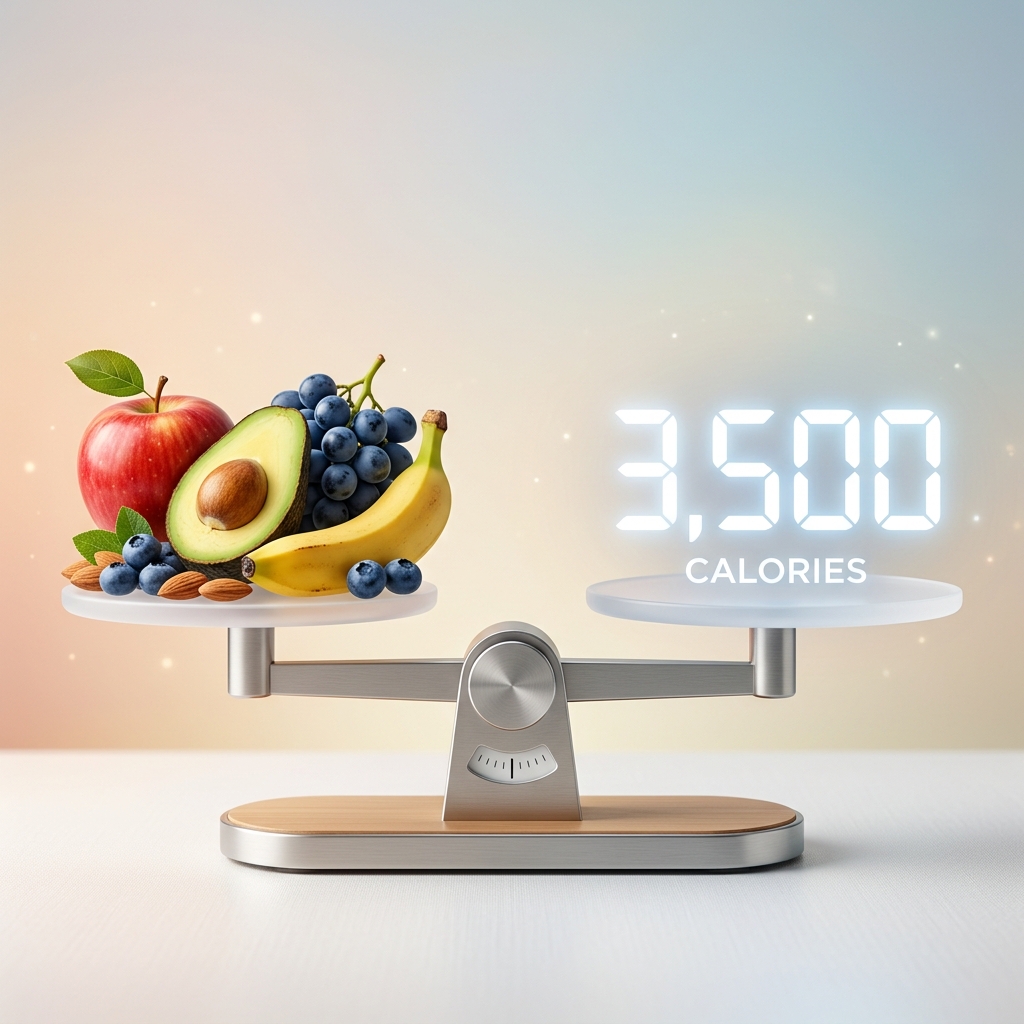
In the world of nutrition and weight management, the standard benchmark is that 3,500 calories equal a pound of body weight. This means:
- To lose 1 pound, you must create a cumulative deficit of 3,500 calories.
- To gain 1 pound, you must consume a cumulative surplus of 3,500 calories.
This relationship forms the basis of any standard calories to lbs converter or calories to lbs calculator. If you have ever wondered how much calories is lbs, this 3,500 ratio is the key number to remember.
Understanding the math:
- 1 pound of fat = ~3,500 calories
- Daily deficit of 500 calories = 3,500 calories per week (1 pound lost per week)
- Daily deficit of 1,000 calories = 7,000 calories per week (2 pounds lost per week)
The Science Behind the 3,500-Calorie Rule
Why exactly does how many calories equal a pound equal 3,500? This rule comes from research conducted in the mid-20th century by physician Max Wishnofsky.
Wishnofsky calculated that one pound of human adipose tissue (body fat) is not 100% pure fat. It is composed of roughly:
- 87% lipid (fatty acids)
- 13% water and connective tissues
Since one gram of pure dietary fat contains approximately 9 calories, one pound (454 grams) of pure fat would equal 4,086 calories. However, because body fat tissue is only 87% lipid, we calculate: $$\text{Calorie content} = 454\text{ g} \times 0.87 \times 9\text{ kcal/g} \approx 3,553\text{ kcal}$$
Wishnofsky rounded this value to 3,500 calories, establishing the golden rule of weight loss that is still widely used today in calories to lbs conversion formulas.
Direct Calorie to Pound Conversion
Let’s look at how to directly calculate weight changes from calorie surpluses or deficits. If you want to know how many calories convert to pounds, you can use this simple formula:
$$\text{Weight Change (lbs)} = \frac{\text{Calorie Deficit or Surplus}}{3500}$$
Practical Examples:
- If you burn 500 calories on a treadmill: How much weight did you lose? $$500 / 3500 = 0.14\text{ lbs of body fat}$$
- If you consume a surplus of 10,500 calories over the holidays: How much weight will you gain? $$10500 / 3500 = 3\text{ lbs of body fat}$$
Limitations of the Wishnofsky Rule
While the 3,500-calorie rule is an excellent starting point, modern science recognizes that human metabolism is dynamic. When you reduce your calorie intake, your body adapts:
- Metabolic Adaptation (Adaptive Thermogenesis): Your body slows down its energy expenditure to conserve energy.
- Loss of Lean Mass: During a calorie deficit, you don’t just lose fat; you also lose some muscle mass, which has a different calorie density (roughly 600-700 calories per pound of muscle).
- Water Weight Fluctuations: Carbohydrate restriction or sodium changes can cause large fluctuations in water weight, which might mask actual fat loss.
Therefore, while a calories burned to lbs calculator gives an excellent estimate, real-world results may vary slightly over time.
How to Use This Information for Weight Loss
If your goal is sustainable fat loss, you can plan your timeline using the 3,500-calorie conversion:
| Deficit per Day | Weekly Weight Loss | Time to Lose 10 lbs |
|---|---|---|
| 250 kcal | 0.5 lbs | 20 Weeks |
| 500 kcal | 1.0 lbs | 10 Weeks |
| 750 kcal | 1.5 lbs | 6.7 Weeks |
| 1,000 kcal | 2.0 lbs | 5 Weeks |
To calculate your personal calorie needs, first estimate your Total Daily Energy Expenditure (TDEE), and then subtract your desired daily deficit. Always ensure you do not drop below safe nutritional minimums (typically 1,200 calories for women and 1,500 for men unless supervised by a physician).