Calories to Pounds of Fat: What Science Really Says
Explore the biological process of how calories convert to pounds of fat and why the 3,500-calorie rule is a helpful approximation.
Calories to Pounds of Fat: What Science Really Says
If you are tracking your nutrition, you’ve likely seen the formula: calories to lbs of fat is 3,500 calories to 1 pound. But how does this conversion actually work inside the human body? Is it a strict biological law, or is it just an approximation? In this article, we explore the biological process of fat accumulation and breakdown, analyzing how many calories to lb of fat are needed, the role of dietary macronutrients, and how much calories per lbs of tissue are burned by the body.
The Biological Process: How Calories Become Fat
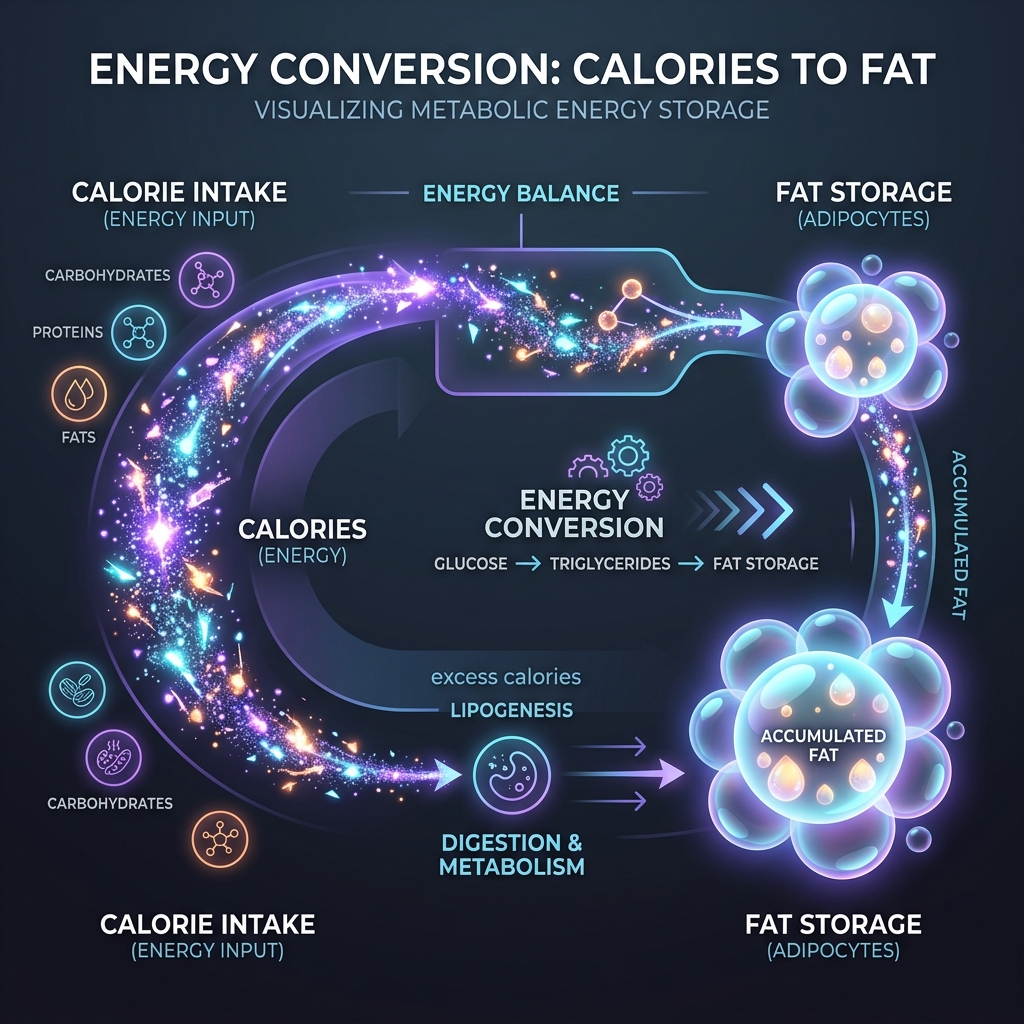
When you consume food, your body breaks down carbohydrates, fats, and proteins into energy. If you consume more energy than your body requires for maintenance, the excess energy is stored.
This process, known as lipogenesis, primarily takes place in your adipose tissue (fat cells):
- Glucose Conversion: Excess carbohydrates are converted into glycogen in the liver and muscles. Once those stores are full, excess glucose is converted into fatty acids.
- Direct Fat Storage: Dietary fat is easily converted into body fat, requiring very little metabolic energy to store (only about 3% of the calories are lost during storage).
- Adipocyte Expansion: Fat cells (adipocytes) expand in size to accommodate the newly formed lipids.
This storage of excess energy is what eventually leads to weight gain. When you accumulate a surplus of 3,500 calories, your body has stored approximately one pound of adipose tissue.
Why Is Body Fat Not Pure Fat?
A common point of confusion is why calories in 1 lb of fat tissue equal 3,500, when a pound of pure dietary fat equals roughly 4,000 calories.
The explanation lies in the structure of human body tissue. Adipose tissue is not 100% lipid. It contains:
- Water (approx. 10% to 12%): Needed to maintain cell structure and hydration.
- Protein and Connective Elements (approx. 2% to 3%): The cellular machinery and membranes holding the lipids.
- Pure Lipid (approx. 85% to 87%): The actual stored energy.
Because of this mixture, the caloric density of one pound of body fat tissue is lower than that of pure oil or butter. Thus, how many calories to lb of fat equals approximately 3,500 kcal, rather than 4,100 kcal.
Macronutrient Differences in Storage Efficiency
Not all calories are stored with the same efficiency. The metabolic cost of converting macronutrients into body fat varies:
- Fats: Very high efficiency (97% stored).
- Carbohydrates: High efficiency, but requires conversion (approx. 75-80% stored due to thermic effect).
- Proteins: Low storage efficiency. The body rarely converts protein to fat unless in extreme surpluses; instead, protein is used for muscle repair or burned as heat (approx. 70% stored).
This is why high-protein diets can sometimes result in better fat loss results, even when total calories are kept constant.
Calories Per Pound of Muscle vs. Fat
It is also important to contrast how much calories per lbs are stored in fat versus muscle tissue. Muscle tissue is primarily water (about 70-75%) and protein (about 20%). Because protein is less calorie-dense than fat (4 kcal/g vs 9 kcal/g) and muscle contains much more water, one pound of muscle tissue only contains about 600 to 700 calories.
| Tissue Type | Caloric Value Per Pound | Water Content | Protein/Lipid Content |
|---|---|---|---|
| Body Fat (Adipose) | ~3,500 kcal | ~10-12% | ~85-87% Lipid |
| Skeletal Muscle | ~600-700 kcal | ~70-75% | ~20% Protein |
This means that if you lose a pound of muscle, your body only frees up 700 calories of energy. Conversely, to build a pound of muscle, you need a smaller energy surplus than you would to build a pound of fat, though muscle synthesis requires additional energy for the building process itself.