Can You Convert Calories to Pounds? Here's Exactly How
Learn how to use mathematical conversion formulas and a calories-to-pounds calculator to track weight loss.
Can You Convert Calories to Pounds? Here’s Exactly How
If you’ve ever tracked your exercise or diet, you’ve seen numbers like “500 calories burned” or “2,000 calories eaten.” But how do these numbers translate to weight changes on the scale? Can you convert calories to lbs? Can you convert calories to pounds directly?
The answer is yes! In this guide, we will look at how to use math to convert calories to weight, explain how many calories convert to pounds, and show you how to use a calories to lbs converter for your fitness tracking.
The Formula: Calories to Lbs Conversion
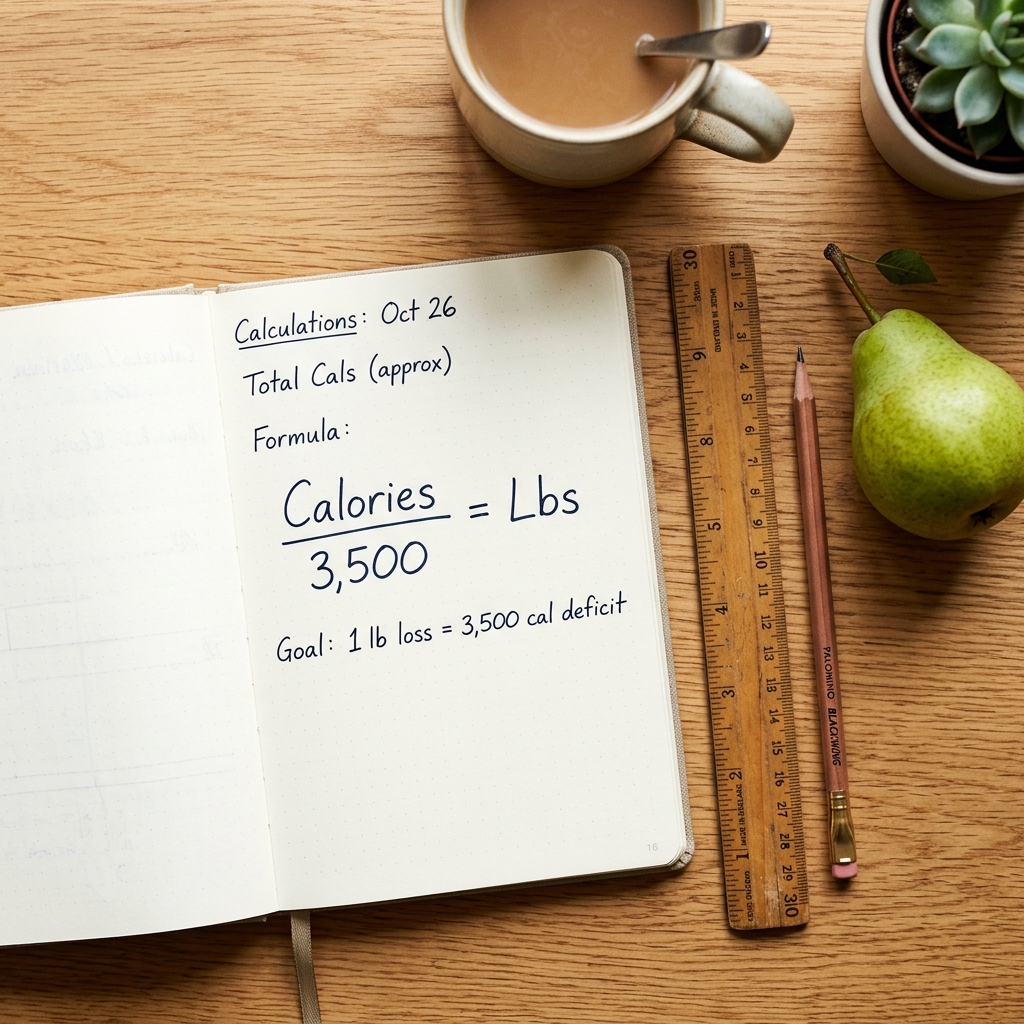
To perform a calories to lbs conversion, we use the standard biological constant that 1 pound of body fat contains approximately 3,500 calories.
Here is the basic equation for converting calories to pounds:
$$\text{Pounds (lbs)} = \frac{\text{Calories (kcal)}}{3500}$$
Converting Deficits to Weight Loss:
If you maintain a daily calorie deficit, you can calculate your expected weight loss over any period.
- Example 1: You create a calorie deficit of 14,000 calories over a month. How many pounds should you lose? $$\text{Weight Loss} = 14,000 / 3500 = 4\text{ lbs}$$
- Example 2: You burn 700 calories in a workout session. What is the equivalent weight loss? $$\text{Weight Loss} = 700 / 3500 = 0.2\text{ lbs}$$
Converting Pounds to Calories
Conversely, if you want to know how many calories are represented by a weight goal, you multiply by 3,500:
$$\text{Calories} = \text{Pounds} \times 3500$$
- To lose 5 pounds: Deficit of 17,500 calories.
- To lose 10 pounds: Deficit of 35,000 calories.
- To lose 20 pounds: Deficit of 70,000 calories.
Using a Calories to Lbs Calculator
While doing the math manually is simple, using an online calories to lbs calculator simplifies the process. A calculator can help you:
- Input varying daily calorie intakes.
- Factor in days with different workout intensities.
- Visualize your weight loss progress over weeks or months.
Important Caveats in Weight Conversion
When converting calories to pounds, it is important to remember that human biology is not a simple machine. The scale might not match your calculations exactly due to:
- Water Retention: High sodium or carbohydrate intakes can cause your body to hold water, masking fat loss.
- Glycogen Levels: Your muscles store carbohydrates as glycogen, which binds to water. Glycogen fluctuations can cause short-term weight changes of 2-5 pounds.
- Muscle Gain: If you are lifting weights, you may be building muscle while losing fat, meaning the scale weight will change more slowly than your fat loss calculations suggest.